
Updated on: May 13, 2026
At Deep River Family & Cosmetic Dentistry, we know that your family’s safety is your top priority. Whether you’re a student at High Point University or a long-time resident of Emerywood, you might have wondered: “How much radiation is safe, and are these x-rays really necessary?”
The truth is that there are no set limitations on how many x-rays can be taken within a month, but we follow the As Low As Reasonably Achievable (ALARA) principle. Unless an x-ray is required to diagnose a dental emergency, we typically recommend bite-wing x-rays only once a year as a baseline.
Comparing the Radiation: The PTI Airport Rule
One of the biggest misconceptions is the amount of radiation involved in a dental x-ray. To put it in perspective for our North Carolina residents, a single digital dental x-ray has about the same amount of radiation as a short round-trip flight from Piedmont Triad International (PTI) to Atlanta.
In fact, you likely absorb more environmental radiation just by walking around High Point City Lake on a sunny afternoon than you do during a routine check-up in our office. Because we use advanced digital sensors, our radiation levels are up to 80% lower than those of traditional film x-rays.
The Furniture Capital Metaphor: Seeing the Frame
High Point is the Home Furnishings Capital of the World, and we like to think of your teeth much like a piece of high-quality handcrafted furniture. An artisan can’t judge the structural integrity of a sofa just by looking at the upholstery; they need to know the frame is solid.
Similarly, Dr. Bray cannot see what is happening between your teeth or under the gumline with a visual exam alone. X-rays allow us to see the internal joinery of your smile, catching small issues before they become expensive structural problems.
The North Carolina Factor: Sinus Pressure vs. Tooth Pain
If you’ve lived in the Piedmont Triad for any length of time, you know all about our famous yellow dust pollen seasons. North Carolina’s heavy pollen often leads to intense sinus pressure, which can feel exactly like a throbbing toothache.
We frequently see patients from Sherrod Park or Piedmont Center who are worried they need a root canal, when in reality, they are just suffering from NC allergies. A quick, safe digital x-ray allows Dr. Bray to see the relationship between your tooth roots and your sinus cavities, ensuring we treat only what is necessary.
Our Precision Imaging Approach
At Deep River Family & Cosmetic Dentistry, we don't believe in a one-size-fits-all approach to your health. Just like a furniture artisan in the Piedmont Centre uses different tools for fine carving versus structural framing, we use specific types of digital x-rays to get a complete structural inspection of your smile.
By using these advanced tools, Dr. Bray can identify issues long before they cause pain or require expensive emergency treatment.
The Panoramic View: Your Landscape Scan
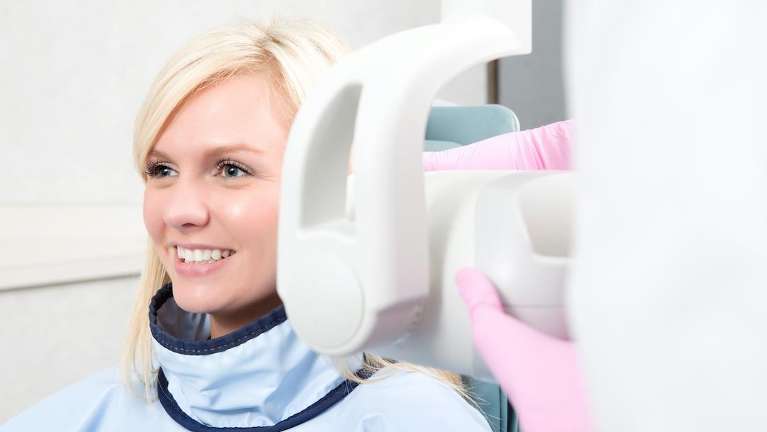
Think of a panoramic x-ray as a wide-angle, landscape photo of your entire mouth. This machine circles your head to capture a single image of your teeth, jaw joints (TMJ), and sinus passages. This is our most valuable tool for checking wisdom teeth or verifying if that toothache is actually a sinus infection.
Periapical (PA) X-Rays: The Macro Close-Up
If the panoramic is the landscape, a periapical x-ray is the macro close-up. It focuses on one or two specific teeth from the crown to the very tip of the root. If you visit us near HPU with a specific zing or sharp pain, we use this tool to spot tiny fractures or infections.
What Dr. Bray is Looking For (That the Naked Eye Misses)
Regardless of which lens we use, our goal is to perform a deep-dive inspection into the areas of your mouth that are hidden from view. In every scan, we are looking for:
- Hidden Decay: Catching cavities that hide between teeth or under existing fillings before they reach the nerve.
- Bone Health: Monitoring for bone loss, which is a primary indicator of gum disease (periodontal disease).
- Deep Infections: Spotting abscesses or cysts at the root of the tooth that haven't started hurting yet.
- Structural Integrity: Ensuring that your existing crowns and bridges are still "seated" perfectly and protecting your natural teeth.
Contact Our Family Dentist in High Point
If you have questions about dental x-rays, contact your High Point dentist at (336) 883-1371 for more information.